Self Drive Tour

Prairie, Presidents and the Painted Badlands

14 Days 13 Nights

From £1879.00 per person

United States

Comfort

Prairie, Presidents and the Painted Badlands: A North Dakota Adventure

North Dakota doesn’t announce itself. It earns you. From the flat, sky-filled farmland of the Red River Valley in the east to the sculpted buttes and painted badlands of the west, this is a state that rewards the curious traveller prepared to cover some ground — and the driving is considerably better than you’d ever expect.

This thirteen-night loop departs and returns to Fargo, crossing the state from east to west along the I-94 corridor before swinging north through the MHA Nation and Lake Sakakawea, up to Minot and the Canadian border, then east along US-2 — a completely different road through a completely different landscape — via Grand Forks. Every stop earns its place. The routing is logical, the distances are manageable, and the range of what you’ll encounter is genuinely remarkable: frontier history, Native American culture, the world’s finest new presidential library, big-sky prairie, sculpted badlands, and one of the most peaceful borders on earth.

The tour connects naturally at the western end for travellers continuing into South Dakota, Wyoming, or Montana.

Prairie Presidents and the Painted Badlands - North Dakota Self Drive
Departure

Fargo

Departure Date

Various

Price From

£1879 per person

Price Includes
  • 13 Nights' Accommodation

  • Standard SUV Rental Vehicle

  • Local accommodation taxes

Price Excludes
  • Flights (please let us know if you would like flights including at the time of enquiry)

  • Meals (unless shown in inclusions)

  • Anything not shown as included

Tour Gallery
Itinerary
  • Day 1: Fargo - Arrival

    Collect your car at Fargo Hector International and head straight into the heart of downtown. Fargo has shaken off its film-noir reputation and reinvented itself as a genuinely vibrant small city — good food, independent shops, a strong arts scene, and the kind of walkable Broadway district that makes an arrival night feel like the start of something rather than just a bed.

    Check in at the Hotel Donaldson on North Broadway — a 17-room boutique gem in a century-old brick building where every room has been designed by a different local craftsperson. There are only 17 rooms, which tells you something about the atmosphere. It’s the kind of place that makes you wish you’d booked an extra night.

  • Day 2: Fargo - First Impressions of a City That Surprises

    Your full second day is for Fargo itself. The Plains Art Museum is the anchor — a former warehouse turned contemporary arts space with a strong regional collection that gives real context to the landscape you’re about to drive through. The Fargo Air Museum is worth an hour if aviation is your thing, and the Red River makes for an easy evening walk along the bank. The Fargo Moorhead food scene punches well above its weight — take your time with it.

    Overnight: Hotel Donaldson, Fargo

  • Day 3: Fargo to Jamestown — Buffalo Country

    The drive west to Jamestown is a gentle 100 miles on I-94, the prairie opening up around you as the city falls away. Jamestown is a functional overnight with a genuinely entertaining reason to stop: the World’s Largest Buffalo.

    Dakota Thunder stands 26 feet tall and weighs 60 tons — a concrete bison on a hill above town that is simultaneously absurd and magnificent. Beside it, the National Buffalo Museum tells the story of the animal that defined the Great Plains — including a live herd visible from the observation deck, among them the rare white bison White Cloud. Frontier Village below is a recreated 1880s prairie town worth an hour of wandering.

    Jamestown is not a destination in itself, but it’s a proper plains stop with genuine character — and the buffalo alone justify the detour.

    Overnight: My Place Hotel, Jamestown — functional, clean, and roomy. Everything you need for a one-night stop, nothing superfluous.

  • Days 4 & 5: Jamestown to Bismarck — Capital City on the Missouri

    Today’s drive of around 100 miles continues west on I-94. Pull over at Salem Sue near New Salem — the world’s largest Holstein cow, a giant fibreglass landmark on a hilltop that somehow makes perfect sense out here — and arrive in Bismarck with enough afternoon left to find your bearings on the Missouri River.

    Bismarck rewards two nights. The North Dakota Heritage Center and State Museum is unexpectedly excellent: a full T. rex skeleton, Plains Indian beadwork, agricultural history, and a Mars spacesuit all under one roof. The State Capitol — a 19-storey Art Deco tower that rises surreally above the flat plains, built during the Depression for two million dollars — is one of the most unusual capitol buildings in America and worth a guided tour. The Lewis and Clark Riverboat runs summer cruises on the Missouri that put the scale of the river in proper context.

    Devote your second day to the Lewis and Clark Trail. Start at Fort Abraham Lincoln State Park south of the city, where reconstructed Mandan earthlodges give a powerful sense of the culture the Corps of Discovery encountered. Then drive north on the Sakakawea Scenic Byway — a 70-mile route along the Missouri River Valley that ranks among the finest drives in the state — to Knife River Indian Villages National Historic Site near Stanton.

    This is where Sacagawea was living when Lewis and Clark hired her husband Charbonneau as an interpreter, and where she agreed to join the expedition. The reconstructed earthlodge beside the visitor centre is extraordinary: 42 feet across, 15 feet high, built with traditional materials, and utterly convincing. The circular depressions in the surrounding grass are all that remain of a village that once housed hundreds of people. It is one of the most quietly moving historic sites we know of anywhere in the American plains.

    Overnight: Staybridge Suites Bismarck by IHG (2 nights) — consistently well-rated, spacious, and a cut above the competition in this market.

  • Day 6: Bismarck to Medora — Into the Badlands

    The drive from Bismarck to Medora (around 135 miles west on I-94) is the one that changes the mood of the whole trip. The landscape shifts within the first hour — the flat prairie gives way to rolling breaks — and then, as you approach Medora, the earth suddenly drops away into a world of sculpted buttes, coloured canyons, and ancient river valleys.

    Consider the Enchanted Highway detour on the way. Exit 72 off I-94 near Dickinson leads south to a 32-mile stretch of road lined with enormous steel sculptures created by local artist Gary Greff — geese in flight, grasshoppers, deer crossing, pheasants on the prairie. Roadside art on a genuinely ambitious scale, and entirely free.

    Pull into the Painted Canyon Overlook before descending into Medora. It’s the first proper view of the badlands and the moment most travellers realise they’ve underestimated North Dakota.

    Medora itself is a small frontier town that wears its history well. Check into the Rough Riders Hotel — North Dakota’s oldest hotel, built in 1884, with a grand hearth, tin-tiled ceilings, and one of the finest private libraries of Theodore Roosevelt books you’ll find anywhere. Ask for one of the eight historic rooms; there are rumours Roosevelt himself once spoke from the balcony. The evening belongs to the Medora Musical — an outdoor variety show staged against a Badlands backdrop that is unashamedly theatrical and enormous fun.

    Overnight: Rough Riders Hotel, Medora (3 nights)

  • Day 7: Medora — Theodore Roosevelt National Park

    An early start. The South Unit of Theodore Roosevelt National Park is best experienced before the day heats up and the wildlife retreats to the shade.

    The 36-mile South Unit Loop Drive is the backbone of the day — a road that winds through the full drama of the badlands past prairie dog towns, bison herds that cross at their own pace, wild horses on the ridge lines, and viewpoints that justify every mile of the journey here. Key stops include Wind Canyon (a short trail to an extraordinary viewpoint over the Little Missouri River), Boicourt Trail for a closer look at the layered formations, and Buck Hill for the widest panorama in the park.

    If the day allows, drive north to the North Unit — 68 miles but worth it. The 14-mile North Unit Scenic Byway is less visited and arguably more dramatic: the canyon walls are taller, the solitude is greater, and the longhorn cattle that roam here add an almost cinematic quality to the landscape.

    Overnight: Rough Riders Hotel, Medora

  • Day 8: Medora — The Theodore Roosevelt Presidential Library

    The Theodore Roosevelt Presidential Library, opening 4 July 2026, sits on a 93-acre site above Medora, folded into the hillside with prairie rolling over its roof and views aimed directly at the valley that shaped its subject. Allow a full day — this is the centrepiece of the whole itinerary.

    The chronological galleries trace Roosevelt’s life in an order that makes cause and effect clear: the Badlands years feed directly into his conservationism, his appetite for reform, his understanding of land and duty. The interactive technology has been built for a new generation of visitors — hands-on, immersive, and paced for those who learn by doing. An internal wall of extraordinary height mirrors the layered colouring of the Badlands in its very fabric: ochres, ash greys, and deep rusts that echo the formations visible through the windows.

    The standout detail is the recreation of the Elkhorn Ranch cabin interior. Combined with photographs Roosevelt took and developed himself, it brings him down from the myth and back into daily life in a way that stays with you.

    Walk the paths out to the butte edge before you leave. The view over the Little Missouri valley — the country that turned a wealthy easterner into one of America’s greatest conservationists — is the perfect final note on three days in Medora.

    Overnight: Rough Riders Hotel, Medora

  • Day 9: Medora to New Town — MHA Nation and Lake Sakakawea

    Today’s drive north (around 120 miles on US-85 and Highway 23) takes you into a completely different North Dakota: the Fort Berthold Reservation, home of the Mandan, Hidatsa and Arikara Nation — the MHA Nation, or Three Affiliated Tribes.

    This is not an incidental stop. The Mandan and Hidatsa peoples are the same nations Lewis and Clark encountered at Knife River. The MHA Interpretive Centre west of New Town tells their story through permanent exhibits, living history programmes, and a world-class museum that puts their culture on its own terms rather than through the lens of exploration history. Guided tours are available by advance booking; the outdoor earthlodge village gives a vivid sense of daily life on the Northern Plains.

    The setting alone justifies the night. Lake Sakakawea — one of the largest reservoirs in America, formed by the Garrison Dam on the Missouri River — spreads across the horizon in every direction, and the Four Bears Bridge crossing is genuinely spectacular. Check in at the 4 Bears Casino & Lodge on the lake’s edge: the Bison Room Steakhouse overlooks the water, the rooms are comfortable, and the location at sunset is extraordinary.

    Overnight: Van Hook Territorial Inn — the first independently-owned inn within ten miles of Lake Sakakawea. Kitchenette suites, lake views, hot breakfast included, and a bar-restaurant next door within easy walking distance.

  • Days 10 & 11: New Town to Minot — The Scandinavian North

    The drive to Minot (around 90 miles north on Highway 83) passes through the wide agricultural heart of the state — big sky, long sight lines, and a landscape that feels genuinely empty in the best possible way.

    Minot is the surprise of the loop. North Dakota’s fourth-largest city has a strong Scandinavian heritage and a cultural confidence that catches first-time visitors off guard. Start at the Scandinavian Heritage Park — a 14-acre outdoor museum that is the only one in the world to represent all five Nordic countries. Full-scale replicas include a 240-year-old Norwegian log house, a traditional Stave Church, a Finnish sauna, a Danish windmill, and a 25-foot Swedish Dala horse. It sounds eccentric; it’s genuinely absorbing. Allow a couple of hours.

    Your second day in Minot is free for the Peace Garden day trip — see the suggested itinerary below.

    Overnight: Hyatt House Minot (2 nights) — apartment-style suites with full kitchens, complimentary hot breakfast with made-to-order omelettes, and an H Bar for evening drinks and dinner. Ten minutes from the Scandinavian Heritage Park and well positioned for the Peace Garden day trip.

    Suggested Free Day: The Peace Garden Loop

    This makes a full and varied day from Minot, heading north and returning via a different route.

    Rugby (65 miles east on US-2): The geographical centre of North America, marked by a 21-foot fieldstone cairn on a heart-shaped base. A brief but satisfying stop — the kind of quirky landmark that earns its place on a road trip of this calibre.

    Bottineau / Mystical Horizons: North Dakota’s answer to Stonehenge — six granite walls forming a functioning solar calendar, aligned to the solstices. The views across the prairie toward the Turtle Mountains are striking.

    Lake Metigoshe State Park: A complete contrast — forested hills, clear glacial lakes, birding trails, and easy walking. This is where North Dakota suddenly looks like Minnesota. Lunch at the Metigoshe Drive-In (cash only; call ahead as waits can be long).

    International Peace Garden: The main event. Allow two to two-and-a-half hours. Formal gardens straddling the US-Canada border across 2,300 acres of prairie and forest — floral displays, peace towers, walking paths between two countries with no barrier and no fanfare. Bring a photo ID to re-enter the US; a passport speeds things up.

    Tommy the Turtle, Dunseith: On the return south, stop for the W’eel Turtle — a 26-foot turtle built from over 2,000 recycled wheels, mounted on the world’s largest snowmobile. Pure North Dakota.

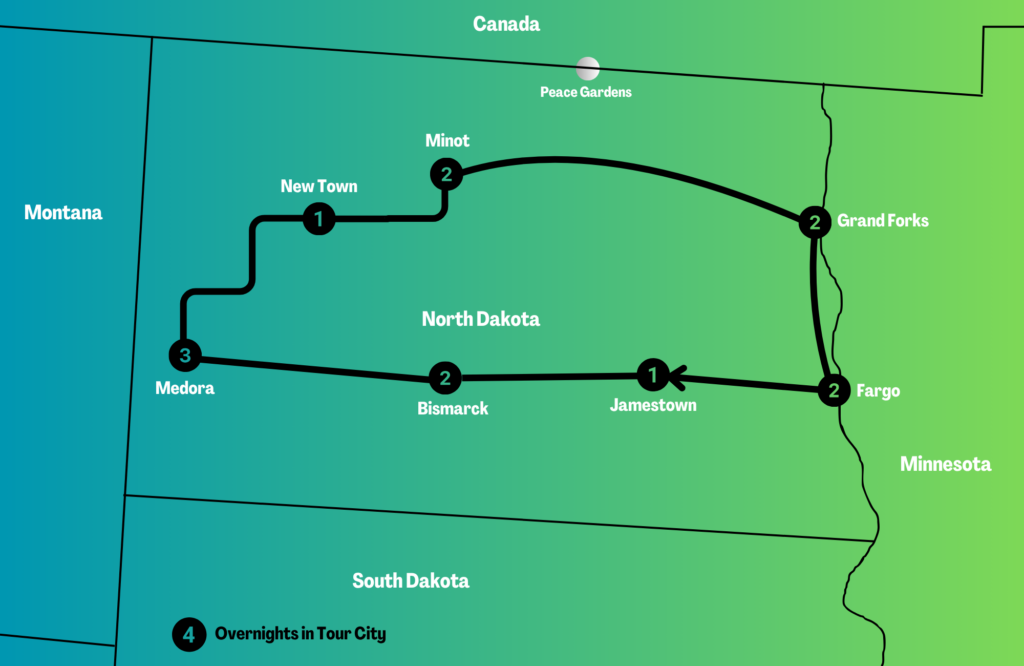
  • Days 12 & 13: Minot to Grand Forks — The Northern Return

    The drive east from Minot to Grand Forks on US-2 (around 155 miles) is a different North Dakota entirely from the I-94 corridor you drove west. The northern prairie is wider, quieter, and in summer, alive with colour — canola fields stretching to the horizon in vivid yellow, wildflowers in the verges, and a sky that seems larger than anywhere else you’ve been.

    Grand Forks repays two nights. The city sits at the confluence of the Red River and Red Lake River, and its 2,200-acre Greenway — transformed from flood-prone land after the catastrophic 1997 flood — is a lovely stretch for an evening walk along the riverbank. The North Dakota Museum of Art is the cultural anchor: housed in a 120-year-old former university gymnasium, it holds serious contemporary exhibitions with regional, national, and international reach, including a permanent collection with pieces by Picasso and Dali. The Empire Arts Center nearby occupies a converted fire hall and hosts theatre, cabaret, and film.

    Downtown Grand Forks has a genuine independent food and coffee scene driven partly by the University of North Dakota — livelier in the evenings than the population might suggest. The Urban Stampede coffee house in a former furrier shop is a particular find. Your second day is free for the Red River, the university campus, independent shopping, or simply slowing down before the final run to Fargo.

    Overnight: The Olive Ann Hotel, Grand Forks (2 nights) — a boutique property that opened in 2023, part of the Marriott Tribute Portfolio, inspired by aviation pioneer Olive Ann Beech. Excellent rooms, attached restaurant, walkable downtown location.

  • Day 14: Grand Forks to Fargo — Home via the Red River Valley

    The final drive south on I-29 from Grand Forks to Fargo is a straightforward 80 miles along the Red River Valley — flat, fast, and in summer, beautiful in its own quietly monumental way. You’ll be back in Fargo by mid-morning with the whole day ahead before your flight.

    Use it well. A final morning on Broadway, a proper lunch at one of the restaurants you missed on the way out, and a last look at the Red River before heading to the airport. North Dakota is rarely the destination travellers expected. It almost always becomes one of the trips they talk about most.

Hotels
  • Fargo

    Hotel Donaldson, Fargo

    The HoDo, as locals know it, is one of those hotels that makes you feel immediately that you've made the right choice. Seventeen rooms in a century-old brick building on North Broadway, each designed by a different North Dakota artist or craftsperson — so no two are alike, and all of them have genuine character rather than the manufactured kind. The ground floor restaurant and wine bar are among the best in Fargo, and the rooftop is a summer institution. For a city that surprises most first-time visitors, the Hotel Donaldson is the perfect introduction.

  • Jamestown

    My Place Hotel, Jamestown

    Not every night on a road trip needs to be a destination in itself. My Place Hotel in Jamestown is honest about what it is — a clean, spacious, well-run extended-stay property that gives you everything you need for a one-night stop and nothing superfluous. Rooms come with full kitchens, the beds are comfortable, and the welcome is genuine. After a day on the prairie with the World's Largest Buffalo, it's exactly right.

  • Bismarck

    Staybridge Suites Bismarck by IHG

    In a city where the hotel options are functional rather than inspiring, the Staybridge Suites consistently outperforms the field. Spacious studio and suite rooms, a complimentary hot breakfast, and a relaxed communal feel make it a natural base for two nights of serious exploring along the Missouri River corridor. It's not boutique, but it's well above average — and after long days at Knife River and Fort Lincoln, the extra room to spread out is quietly appreciated.

  • Medora

    Rough Riders Hotel, Medora

    North Dakota's oldest hotel, built in 1884, and still the best place to stay in the Badlands. The Rough Riders wears its age beautifully — grand stone fireplace, tin-tiled ceilings, walls lined with Roosevelt memorabilia, and one of the finest private collections of books on the man himself you'll find anywhere. Ask for one of the eight historic rooms; the newer additions are comfortable enough, but the originals have the atmosphere. Theodore's Dining Room downstairs is excellent, the location in the heart of Medora is perfect, and the knowledge that Roosevelt himself almost certainly drank whiskey somewhere in this building is the kind of detail that makes a hotel stay feel like part of the story.

  • New Town

    Van Hook Territorial Inn, New Town

    The first independently-owned inn within ten miles of Lake Sakakawea, and it shows — there's a proprietorial pride here that chain properties rarely manage. Kitchenette suites are spacious and well-equipped, the complimentary breakfast sets you up properly for a day on the road, and the location close to the Van Hook dock means lake views come as standard. The bar and restaurant next door handles dinner without any need to get back in the car. For a night spent in MHA Nation country, beside one of the largest reservoirs in America, it's a quietly memorable place to stay.

  • Minot

    Hyatt House Minot

    The best hotel in Minot by a comfortable margin, and a genuine pleasure after several nights of frontier lodgings. Apartment-style suites come with full kitchens, proper living areas, and the kind of space that makes a two-night stay feel genuinely restful rather than merely functional. The complimentary hot breakfast — made-to-order omelettes included — is better than it has any right to be, and the H Bar handles evening drinks and dinner without needing to leave the building. Ten minutes from the Scandinavian Heritage Park, well positioned for the Peace Garden day trip, and frankly the sort of hotel you'd be happy to find in a much larger city.

  • Grand Forks

    The Olive Ann Hotel, Grand Forks

    Opened in late 2023 and already the most talked-about place to stay in Grand Forks, the Olive Ann is part of Marriott's Tribute Portfolio — the collection reserved for independent-spirited hotels with genuine character. Named for aviation pioneer Olive Ann Beech, the design carries subtle aviation references throughout without tipping into theme-hotel territory. High ceilings, beautiful rooms, an excellent attached restaurant, and a downtown location that puts the Red River Greenway and the North Dakota Museum of Art within easy walking distance. For the final two nights of the loop, it's a very fine place to slow down and take stock of what has been, by any measure, an extraordinary drive.

Highlights

  • The brand-new Theodore Roosevelt Presidential Library — opening 4 July 2026, one of the most extraordinary new museums in America
  • Theodore Roosevelt National Park — bison, wild horses, prairie dogs and painted canyon landscapes
  • The Lewis and Clark Trail — Fort Mandan, Knife River Indian Villages, and the story of Sacagawea
  • MHA Nation and Lake Sakakawea — the living continuation of that same story, told on its own terms
  • The International Peace Garden — 2,300 acres straddling the US-Canada border, open and borderless
  • Minot’s Scandinavian Heritage Park — the only outdoor museum representing all five Nordic countries
  • Rugby — the geographical centre of North America, marked with a 21-foot cairn on the prairie
  • Grand Forks — a riverfront college city with a serious arts scene and one of the best new boutique hotels in the state
  • Two nights in Fargo — one of America’s most underrated small cities, bookending the trip
  • Stays in characterful independent properties throughout — from a 140-year-old frontier hotel to an aviation-inspired boutique

This itinerary is fully flexible and can be customised to suit your individual needs. Simply send us your request, and we’ll be delighted to provide a personalised quote.

The Man the Badlands Made

Theodore Roosevelt first came to North Dakota in 1883, a young, ambitious New York assemblyman who wanted to shoot a buffalo before they were gone. He was 24, slight, short-sighted, and not entirely taken seriously. The Badlands had other plans for him.

Within a year he had lost both his mother and his wife on the same February night. He retreated to the Dakota Territory, bought a second ranch, and threw himself into the physical life of the frontier — riding, roping, hunting, enduring. He slept rough, chased outlaws, and worked alongside men who had no interest in his politics or his pedigree.

The land changed him. The scale of it, the silence, the indifference of the prairie to human ambition — all of it stripped something away and left something harder and more useful in its place. He later wrote that the man he became in public life was shaped directly by the years he spent in the Badlands. Without North Dakota, he believed, there would have been no presidency.

He left the territory for good in 1887, but he never stopped thinking of it as home. When he fought to establish the national parks and forest reserves that remain his greatest legacy, it was this landscape he was protecting. The sweeping conservation policies of his presidency — over 230 million acres of public land preserved — grew directly from the man who once stood on a Badlands butte and decided that some things were worth keeping.

The library that bears his name sits on that same ground. It feels less like a memorial and more like a return.

We gratefully acknowledge the photographers and sources whose images help bring our content to life. All photos are used with permission or sourced from licensed providers. Please contact us if you believe any credit has been omitted or if you wish to request removal of an image.

Specific credits go to:

North Dakota Tourism

Leave a Comment:

Your email address will not be published. Required fields are marked *
