
November 30, 2025

If you stand on a quiet dock somewhere along British Columbia’s coast at dusk, you can hear the place breathing. The water slaps against the pilings, ravens complain from the trees, and a ferry horn echoes across the bay. It feels remote, but not empty. You’re on the edge of real life, not a theme park.
This is what draws so many travellers to British Columbia coastal towns and their surrounding forests. Away from the glossy postcards and packed viewpoints, there are small communities and deep, mossy woods that still feel wild and lived in at the same time.
This guide is for independent travellers who like to move at their own pace, mix short hikes with good coffee, and treat Indigenous land and local communities with respect. Think of it as advice from a friend who has already driven the long, winding roads and taken the late-night ferry for you.
The Pacific coast of British Columbia is a tangle of islands, fjords, and thick forest. Even with big names like Vancouver and Tofino on the map, much of the shoreline is dotted with small towns, logging roads, and traditional Indigenous territories that see far fewer visitors.
If you want a broader sense of what small towns look like across the province, this guide to the best small towns in British Columbia gives a helpful overview. Here, though, we focus on coastal spots where the forest almost touches the sea.
What ties these places together is a feeling of distance. Distances on the map are large, ferries matter as much as roads, and the rainforest never feels far away. That mix is perfect for travellers who like to hike during the day, eat fresh seafood at night, then fall asleep to the sound of rain on a cabin roof.
The Sunshine Coast is a gentle way into the wilder side of the province. It is still connected only by ferry, yet feels more lived in than remote. Many visitors stop at Gibsons or Sechelt and call it a day. Keep going.
Powell River has pulp mill roots and a creative streak. Murals, a historic townsite, and good bakeries sit alongside sea views and forested trails. It is a working town, not a polished resort, which is exactly its charm.
Twenty minutes north, tiny Lund marks “Mile 0” of Highway 101. The road stops, the coast keeps going. From the waterfront you can:
Nearby Desolation Sound is popular with boaters, but from shore it still feels quiet, especially outside school holidays.
On the lower Sunshine Coast, Egmont is a cluster of homes, a wharf, and a trailhead. Nothing fancy, just forest, water, and the odd fishing boat heading out.
The walk to Skookumchuck Narrows leads through dripping forest to a narrow channel where the tide rips through like a river. Experienced kayakers surf the standing waves, locals sit on the rocks with flasks of coffee, and the forest hums behind you.
For more seaside town ideas on this stretch of coast, have a look at this “seaside edition” guide to small BC town getaways. It gives a flavour of how many little communities are tucked along the shoreline.
Travel tip: From Vancouver, take the ferry from Horseshoe Bay to Langdale, then drive and connect with another short ferry at Earl’s Cove. Allow a full day if you are heading all the way to Powell River or Lund.
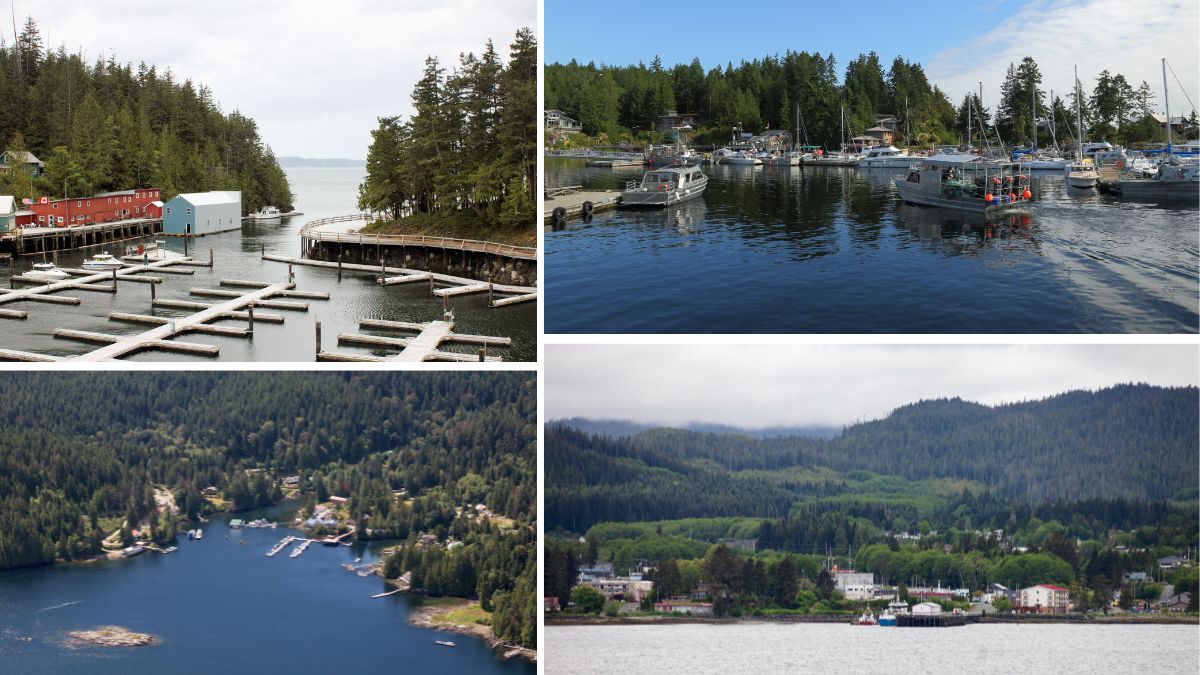
Head up Vancouver Island and the traffic thins out. Forest presses closer to the road, and the towns feel more like outposts.
Port Hardy sits near the top of Vancouver Island, where the paved highway ends and ferries push north towards the Inside Passage and remote Indigenous communities. Fishing boats crowd the harbour, eagles patrol the shoreline, and cloud often hangs low over the hills.
From here you can:
It is not a polished tourist spot, but there is a quiet honesty to it. You are sharing space with people who work on the water and in the forest.
Telegraph Cove is more visited, but still tiny. A boardwalk curls around a sheltered inlet, lined with restored wooden buildings on stilts. It feels like a film set, in a good way, especially at golden hour.
The real payoff is out on the water and in the forest behind. This area is one of the best spots in the region for whale watching. Inland, there are trails through second-growth and pockets of old-growth forest, with nurse logs and thick moss underfoot.
Safety note: This is bear and cougar country. Keep food stored, make noise when walking in dense forest, and follow local advice on wildlife encounters.
Bella Coola sits at the head of a long, steep-sided fjord on the Central Coast. Getting there is half the story. You either arrive by ferry from Port Hardy or by driving the famous “Hill”, a gravel climb that hairpins down from the Chilcotin Plateau.
The town is small, with a mix of Nuxalk Nation culture, fishing history, and modern services. The mountains rise almost straight from sea level, and the valleys hide some of the province’s most impressive old-growth forest.
Many visitors come for guided grizzly bear viewing in late summer and early autumn. If you choose to do this, book with a licensed operator, ideally one that is Indigenous-owned, and follow every instruction about distance and behaviour. In this part of the province, you are very much a guest.
If you want to compare Bella Coola with other lesser-known spots, this overview of underrated BC towns for outdoor adventure gives extra context on how wild small communities can feel once you step away from the cities.
Beautiful views are nice, but knowing when ferries run and how much a cabin costs is what actually helps a trip come together.
Winter travel is possible, especially in the milder coastal zones, but many smaller operators shut or run limited hours. Roads can be icy, storms can disrupt ferries, and daylight is short.
Most travellers arrive via Vancouver or Victoria, then pick up a car or camper. Public transport exists along some corridors, but once you leave the main routes a vehicle gives far more freedom.
If you want more ideas for stringing coastal stops together, this guide to exploring British Columbia’s best coastal towns is a useful planning companion.
Costs vary a lot by season and how simply you travel, but as a starting point for 2025:
Food is pricier in remote communities, especially fresh produce. Supporting local restaurants and cafés is worth it though, as your spending stays in the town.
A few simple habits make these trips safer and more respectful.
Before you travel, read up on small coastal communities and their stories. This round-up of underrated towns in British Columbia is a good reminder that every place has more layers than you see from the car window.
Undiscovered British Columbia is not really undiscovered at all. People have lived along this coast and in these forests for thousands of years. What feels new is your own sense of paying attention.
If you give yourself time, the smaller harbours, ferry terminals, and trailheads reward slow travel. You get misty mornings on quiet docks, the smell of cedar after rain, and maybe a chat with a local in a café who points you towards a favourite cove or viewpoint.
Plan well, travel lightly, and treat this wild corner of the Pacific as the shared home it is. That way your journey through coastal British Columbia will feel less like ticking off a list and more like being welcomed, briefly, into a much larger story.