
August 9, 2026

The first glimpse of Drumheller and the wider Canadian Badlands feels slightly unreal. One minute we’re driving through open Alberta prairie, then the ground drops away into striped canyons, crooked hoodoos and slopes the colour of old clay, revealing a landscape unlike anywhere else on the continent.
We’d give this three days. That’s enough time for the famous fossils, but also for the quieter roads and wide views that make this corner of Alberta so memorable, and the trick throughout is not trying to see every roadside attraction before lunch.
We’d slow down, leave room for unexpected pull-ins along the way, and let the valley do some of the work.
We’d treat the Dinosaur Trail as a relaxed three-day loop rather than a rigid checklist, and allocate at least three to four hours for the world-renowned Royal Tyrrell Museum and its vast collection of prehistoric fossils. We’d base ourselves in Drumheller for all three nights to minimise travel and enjoy easy access to local amenities and evening views, and we’d pack sturdy walking shoes, plenty of water, and sun protection, since the trails here can be exposed and slippery.
Drumheller sits about 135 km north-east of Calgary, making it an easy drive in a hire car after a night in the city. If you are pairing this with a mountain leg, our Canadian Rockies road trip itinerary starts from the same Calgary airport. Most visitors arrive with the Royal Tyrrell Museum at the top of the list, which makes perfect sense, though we’d say the museum is only one part of a region shaped by ancient seas, coal mining, river valleys and 75 million years of geological drama.
We’d treat the loop itself as loose rather than a checklist. Highway 838 follows the east side of the Red Deer River north of town, the free Bleriot Ferry crosses the river, and the road returns along the west side via Highway 837 and Highway 575, forming part of the South Dinosaur Trail. It’s a small drive on the map, but the stops can easily fill a day, and we’ve found it works best as a brilliant scenic route through the heart of the badlands rather than something to rush.
We’d stay in Drumheller itself for all three nights. That keeps luggage shuffling to a minimum and leaves us free to head out early, return for a rest, then enjoy the long evening light. The town has practical places to eat, family-friendly accommodation, and that pleasingly odd giant dinosaur watching over the centre.
Here’s the rhythm we’d suggest for the three days:
| Day | Main focus | Suggested overnight base |
|---|---|---|
| Day 1 | Town sights, hoodoos and the Dinosaur Trail loop | Drumheller |
| Day 2 | Royal Tyrrell Museum and Midland Provincial Park | Drumheller |
| Day 3 | Canyons, suspension bridge and coal-mining history | Drumheller |
The region is at its most straightforward between late spring and early autumn. Summer brings longer opening hours and fuller activity programmes, though it also brings heat, busy car parks and bright midday sun, while May, June and September often feel more relaxed, especially if outdoor activities are the priority.
For a useful sense of the wider area, Travel Alberta’s guide to the Canadian Badlands is worth a browse before setting out — a good reminder that this isn’t a theme park with a few rocks nearby, but an enormous, weathered landscape with stories tucked into every fold.
Three days works because it gives the museum and its surrounding provincial park a proper afternoon, rather than squeezing them between a hurried lunch and a long drive back to Calgary.
We’d start in Drumheller town centre, where the World’s Largest Dinosaur is impossible to miss. This 26-metre T. rex stands right beside the Visitor Information Centre as a gloriously oversized bit of roadside fun, and families will enjoy climbing up inside it to the viewing platform in its mouth — not subtle, but then neither is the rest of the town’s welcome.
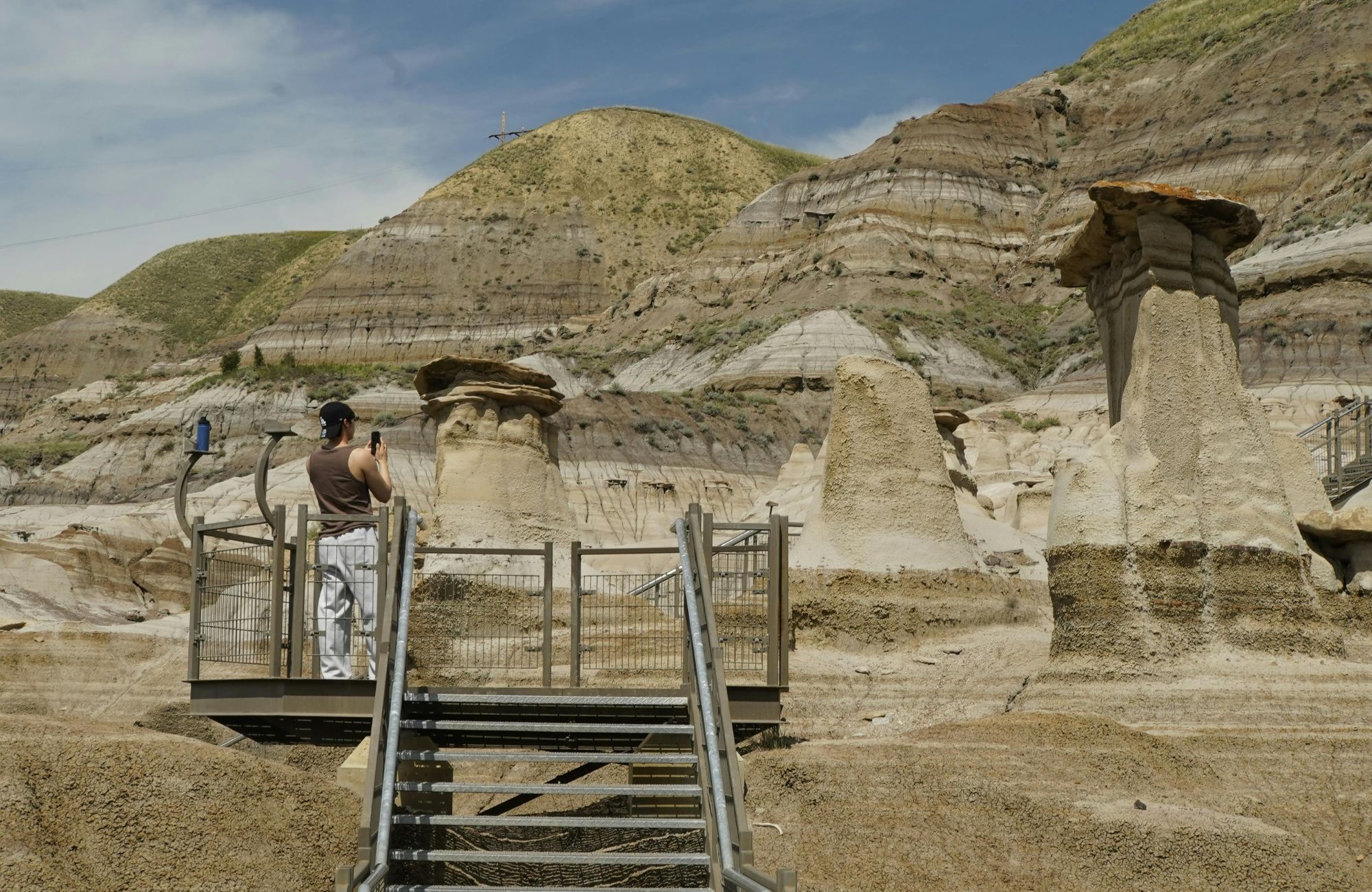
We’d grab coffee and supplies before heading east towards the Hoodoos Trail, where mushroom-shaped sandstone pillars balance hard capstones on softer rock, like little desert castles that have somehow survived a very strange weather system. They’re most photogenic when the light is low, but even at midday they make a fine first encounter with badlands terrain, and being quick and family-friendly, they’re a natural stop for anyone new to this landscape. We’d keep to the marked path, since the surface is fragile and breaks down more easily than it looks.
Afterwards, we’d head back towards town for a relaxed lunch, then drive north on the North Dinosaur Trail. This stretch is less about ticking off one major attraction and more about the feeling of the road, with the Red Deer River winding through the valley bottom and pale ridges rising on either side — we’d pull over only where it’s safe and permitted, since a perfect photo is never worth stopping on a blind bend.
The Little Church makes a sweet optional pause, tiny enough for six people at once, which gives it the air of a miniature film set. Five minutes and a photograph is about right before carrying on.
We’d continue along the North Dinosaur Trail towards Horse Thief Canyon if the weather is clear, where a short walk from the parking area opens onto a broad, deeply eroded valley within the badlands. Layers of grey, tan and rust-coloured earth stretch out below, and it’s easy to see why the name stuck — the story goes that horse thieves once hid stolen animals in this maze of gullies. We’d practise a little restraint here too: faint trails head down the slopes, but the clay can be loose and steep, so unless the footwear, conditions and confidence all line up, the view from above is plenty.
We’d finish the loop by crossing the Red Deer River on the Bleriot Ferry if it’s operating — this cable-operated crossing turns a simple road loop into a small adventure, especially for children who’ve never driven onto a ferry before. Services can pause with weather or water conditions, so we’d keep Highway 575 in mind as a back-up route, or loop back via the South Dinosaur Trail to complete the drive.
For anyone travelling by bike, the pace here is entirely different — the Cycle Alberta Dinosaur Trail route covers 47.7 km, though the hills and exposed conditions suit confident cyclists better than a casual family outing.
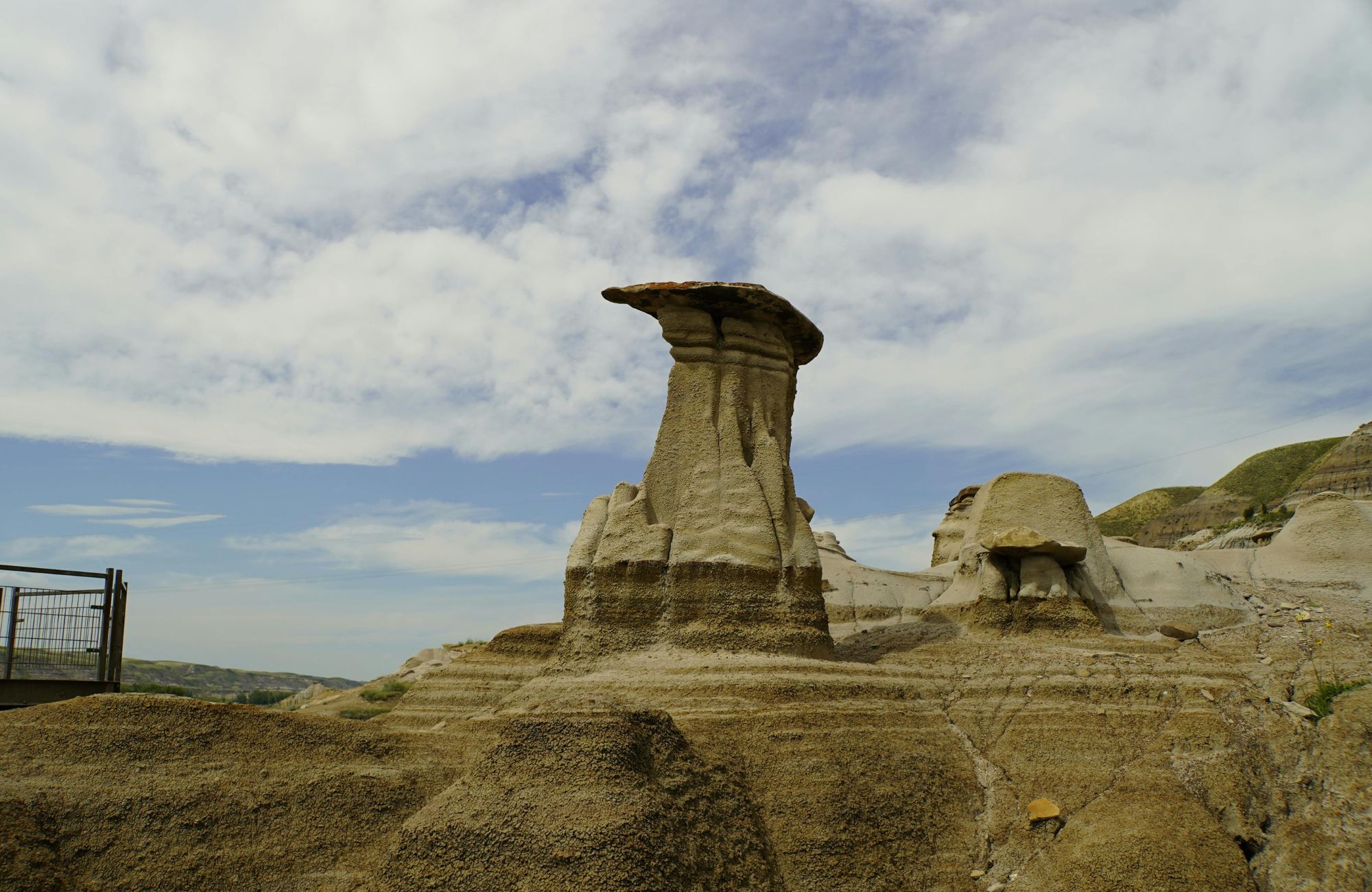
We’d give the Royal Tyrrell Museum the generous chunk of time it deserves. It sits about 6 km north-west of Drumheller in Midland Provincial Park, and stands as Canada’s premier paleontology museum at the heart of any visit here — even people who arrive claiming they’re not really museum people tend to stay longer than planned.
The museum opened in 1985 and houses one of the world’s largest collections of dinosaur fossils. Dinosaur Hall alone displays more than 45 skeletons, but scale isn’t the only draw — we’ve found it’s the closeness that gets you, near enough to see the strange armour, tooth marks and textures that make these animals feel less like movie monsters and more like living creatures caught in a very long pause, drawn from the rich fossil beds found across the badlands.
We’d set aside at least three hours, four if travelling with dinosaur-obsessed children, stopping for lunch, or joining one of the seasonal activities. The large Preparation Lab window is a highlight, letting visitors watch palaeontologists and technicians working on fossils that may one day join the displays.
The famous specimens are worth seeking out, including “Black Beauty”, a 67-million-year-old Tyrannosaurus rex, and “Hellboy”, a horned dinosaur discovered in Alberta in 2005, though the quieter displays can be just as good — fossilised leaves, tiny mammals and marine creatures show that dinosaurs were only part of a much busier ancient world.
We’d book timed activities early if the family would enjoy guided tours, a fossil search or a simulated dinosaur dig, since these programmes are usually seasonal, cost extra, and are worth checking when booking admission.
After the galleries, we’d walk the nearby Badlands Interpretive Trail — an easy way to place the museum’s collection back into the stark, beautiful terrain that produced it. The trail is short, but we’d still take water and sun protection, since there’s little shade and the light bounces hard off the pale ground.
We’d keep the evening easy: back to Drumheller, a browse of a local shop, an unhurried dinner, and letting the day settle. There’s no prize for packing in another viewpoint after several hours staring happily at dinosaurs.
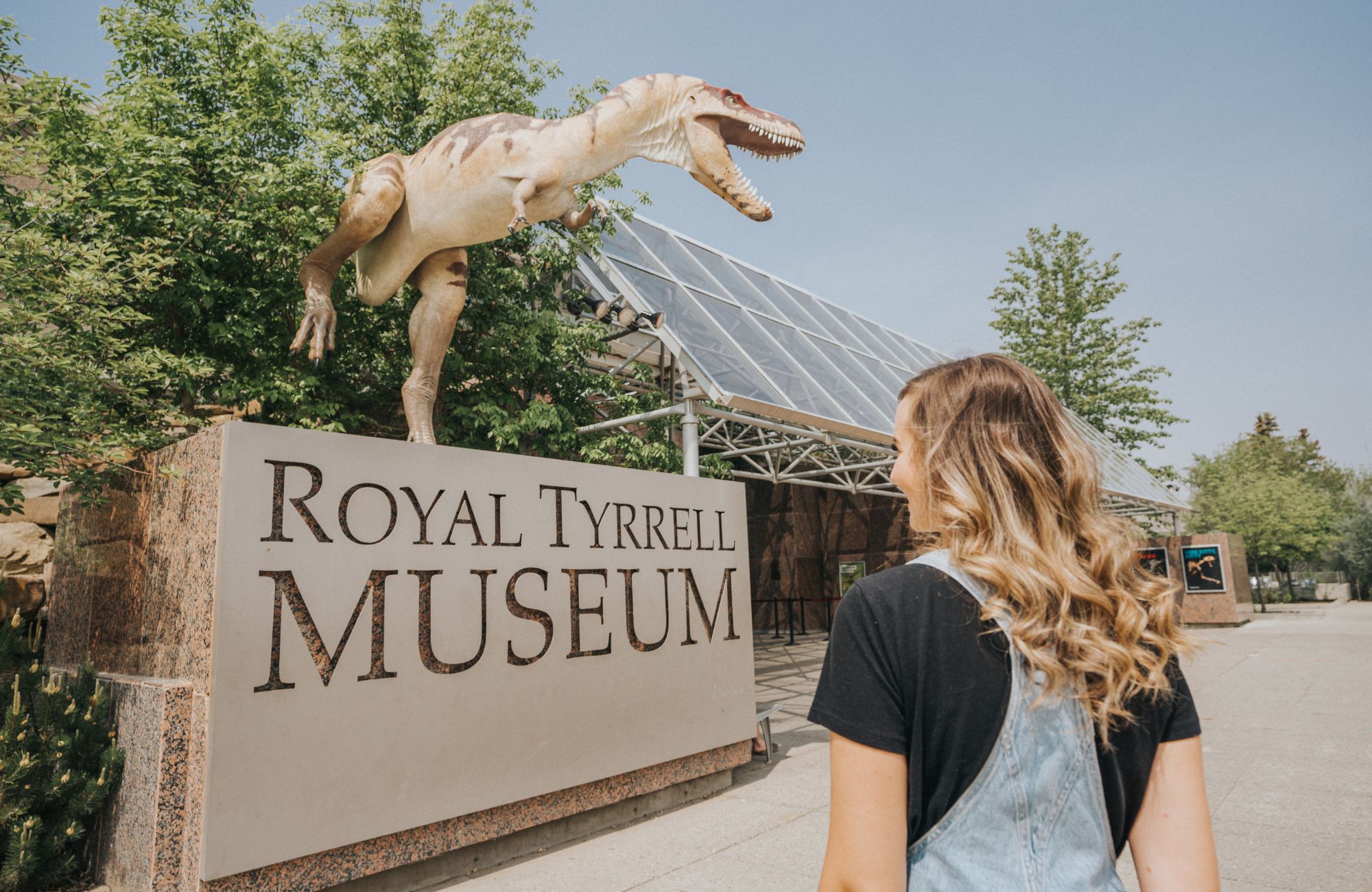
The final day brings together the human history of the valley with a few of its best views. We’d begin at Horseshoe Canyon, just off the South Dinosaur Trail south-west of Drumheller, where the access is simple and the first view has real drama — the canyon opens suddenly beneath you, a ragged bowl of bentonite hills cut by rain and time.
Morning is the best window, when the sun sits lower, the air is cooler, and the overlook is more likely to be quiet. If the trails here tempt you further, we’d choose sturdy shoes with grip and take it slowly, since bentonite clay is slippery when wet and can cling to boots in thick, heavy slabs.
Next, we’d head to the Star Mine Suspension Bridge at Rosedale, where the pedestrian crossing over the Red Deer River offers a fine view of the valley. It’s more modest than some travellers expect, but that’s part of its charm — standing in a former coal-mining community, watching the river move through country that once powered homes and railways.
The Atlas Coal Mine National Historic Site, near East Coulee, is the day’s deeper history stop. Its wooden tipple is one of the last of its kind in Canada, and the site tells a far more grounded story than the town-centre roadside attractions. Families worked in hard conditions here, and the mine’s remaining structures make the past feel close. We’d take a guided tour where available — it adds the people behind the machinery, rather than leaving you with a collection of old buildings and questions — and allow plenty of time to linger, especially for anyone drawn to industrial history or travelling with teenagers who’ve had their fill of prehistoric bones.
On the way back, we’d stop at whatever pull-offs catch the eye. Some of the best moments here happen without a pin on a map — a cottonwood tree by the river, an abandoned-looking shed, a hawk circling over a ridge, the road slipping around another bend. It all feels a little quieter after the museum, which is exactly the point.
Dinosaur Provincial Park is often mentioned alongside Drumheller, but it isn’t next door. It lies near Brooks, around 180 km south-east of Drumheller, so trying to cram it into this three-day plan makes for a long and rather joyless day behind the wheel.
With a fourth day, or if continuing east across Alberta, it’s an outstanding addition. This UNESCO World Heritage Site is famous for its vast dinosaur bone beds, with badlands walks, guided tours, and a landscape that feels far more remote than Drumheller’s river valley.
We’d check the official park information for driving directions, camping, tours and seasonal updates before setting out — the road in is part of the experience, but it’s not a quick detour. For a three-day holiday, we’d leave it for another time. Drumheller has more than enough character on its own, and giving each place breathing room makes the trip better.
A hire car is the practical choice here. Public transport is limited, and the best views sit beyond town along roads where the freedom to pause matters. We’d stop by the local Visitor Information Centre for updated maps and regional safety advice before setting off, pick up the vehicle in Calgary, download offline maps before leaving the airport, and keep a paper map in the glove box for anyone who enjoys the old-school version of route planning.
The distances are manageable, but we wouldn’t let the petrol tank run low — fill up in Drumheller or another larger community before exploring the surrounding roads. Mobile signal can drop in the coulees, and navigation is far less charming when it’s a blinking blue dot with no map beneath it.
We’d pack these basics in the car every day:
Wildlife is part of the pleasure here, but it needs space. We’d watch for deer on rural roads, particularly around dawn and dusk, and never approach animals for a photograph. We’d stick to the posted speed limits, slow down on gravel sections, and avoid pulling off the road where the shoulder is soft or narrow.
We wouldn’t climb unmarked slopes or hunt for fossils. The badlands are fragile, and fossil collecting is restricted — a day spent exploring the Royal Tyrrell Museum makes this easier to appreciate. Those bits of bone and stone aren’t souvenirs. They’re clues, still waiting for someone to read them properly.
How many days do we need for the Drumheller Dinosaur Trail? Three days is the ideal amount of time to explore the main sights, including the Royal Tyrrell Museum, the hoodoos, and the local canyons, without feeling rushed. This gives room to balance the major attractions with quieter scenic drives and unexpected roadside stops.
Is the Royal Tyrrell Museum suitable for children? Yes — it’s exceptionally family-friendly, with fascinating dinosaur skeletons, interactive exhibits, and a large Preparation Lab window where visitors can watch palaeontologists at work. Children especially enjoy the life-sized displays and the chance to learn about prehistoric creatures in an engaging environment.
Can we visit Dinosaur Provincial Park on this three-day trip? We’d generally leave it for a separate trip or a fourth day, since it sits about 180 km south-east of Drumheller. Cramming it into a three-day itinerary results in an unnecessarily long day of driving rather than a relaxed holiday.
What should we wear and pack for exploring the badlands? Sturdy, closed-toe walking shoes with good grip, a refillable water bottle, sunscreen, sunglasses, and a hat, given the exposed and often slippery terrain. A light waterproof layer and basic snacks are also worth having for changing weather and remote stretches of road.
This is not a route to race through with one eye on the clock. Its best moments sit between the famous stops — on a ferry crossing, at a quiet overlook, or in the museum when a 75-million-year-old skull suddenly feels less like an exhibit and more like an encounter.
We’d give the Royal Tyrrell Museum its full afternoon, see the hoodoos and canyons in good light, and let this prehistoric road trip wander a little. The Canadian Badlands reward travellers who leave space for the view.
Request a tailor-made tour option to include the Alberta Badlands.
Comments are closed.
Canadian Rockies Road Trip 2026, 7-Day Banff to Jasper Itinerary
[…] and reach Banff in about 1.5 to 2 hours. If you have a spare day at either end of the trip, the badlands around Drumheller, home of the Royal Tyrrell Museum, are an easy drive north-east of the […]